

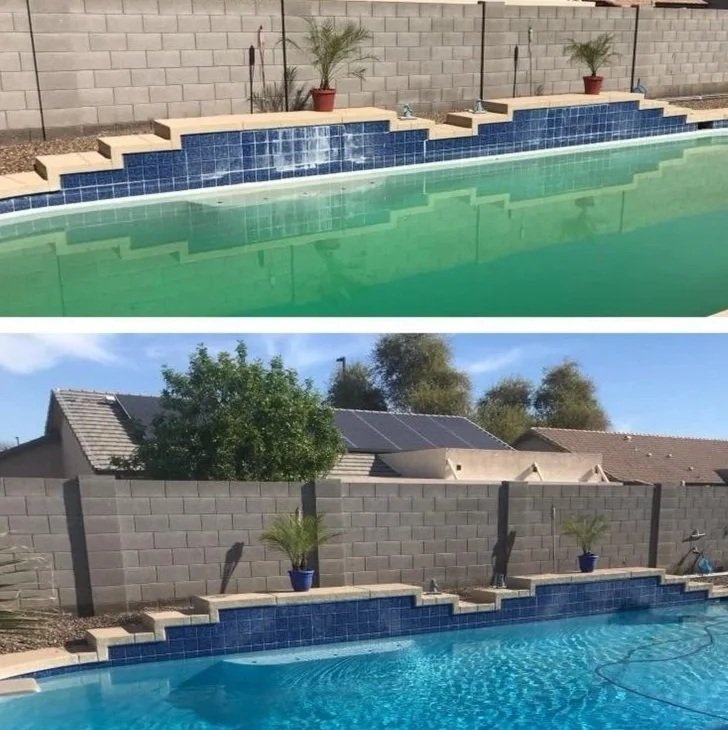
From Green to Clean!
Call Us Today For Us to Rescue Your Pool!
We Rescue Pools and Transform Green Pools into Crystal Clear Water!
Rescue Me Pool Services LLC
By submitting this form, you agree to our Terms and Conditions and Privacy Policy.

Rescuing Pools All Year Long!
From Green to Clean: A Gilbert Homeowner's Guide to Rescuing Your Pool
Key Takeaways for Gilbert Homeowners
Act fast at the first sign of trouble. A slightly "teal" or cloudy pool is much cheaper and easier to fix than a full swamp-green one. Catching it early can save you hundreds of dollars.
Never drain your pool without professional guidance. In Gilbert's extreme heat and hard-water conditions, draining your pool incorrectly can permanently damage the surface, cracking, warping, or even causing the shell to physically "pop" out of the ground.
Prevention beats recovery every time. Weekly professional maintenance keeps your water chemistry stable before problems can develop, especially heading into monsoon season.
My Pool Turned Green Overnight, Now What?
We've all been there. You step outside to cool off in that brutal 110-degree Gilbert heat, and instead of sparkling blue water, you're greeted by something that looks like a murky swamp. Maybe it happened after a massive dust storm blew through, or maybe you came home from a two-week vacation to find a disaster waiting in the backyard.
Here's the reassuring truth: no matter how green your pool is, it can be fixed. Even a pool that's gone full "Shrek-green" can be restored to crystal-clear water. But getting there the right way, especially in Arizona's unique climate, takes more than just dumping a bag of chlorine in and hoping for the best.
This guide walks you through exactly what's happening when your pool turns green, why Arizona makes it especially tricky, and how a professional recovery process actually works from start to finish.
Why Did My Pool Turn Green? Understanding the Arizona Factor
Green pool water is caused by algae, microscopic plant-like organisms that thrive in warm, nutrient-rich water. When your pool's chemistry falls out of balance, even briefly, algae can establish a foothold and multiply rapidly. In most parts of the country, this is primarily due to neglect. In the East Valley, it's often simply nature moving faster than your chemicals can keep up.
The Monsoon Effect
Arizona's summer monsoon storms are spectacular and destructive to pool chemistry. When a haboob rolls through, it doesn't just dump a layer of fine desert silt into your water. It also deposits nitrogen and organic debris like mesquite leaves, pollen, and airborne fertilizers. Nitrogen is essentially an algae fertilizer, and a single storm can introduce enough of it to trigger a full bloom within 24–48 hours, even in a pool that was perfectly balanced the day before.
The "Chlorine Thief": Your Pool's Invisible Enemy
Chlorine is what keeps your pool sanitized and algae-free, but chlorine has a weakness: ultraviolet (UV) light from the sun destroys it. In Arizona, where we average over 300 days of sunshine a year, our intense UV exposure can degrade 50–90% of your pool's chlorine in a single day if your stabilizer (cyanuric acid) levels aren't in the right range.
Think of a stabilizer as a sunscreen for your chlorine. Without it, your pool is essentially unprotected from mid-morning to late afternoon, the exact window when algae growth is at its peak.
Phosphate Build-Up: The Problem Chlorine Can't Solve Alone
Here's something many pool owners don't know: high phosphate levels can make algae nearly impossible to control with chlorine alone. Phosphates come from dust, fertilizers from nearby landscaping, some pool chemicals, and even tap water. They are a direct food source for algae. If your phosphate levels are elevated, you can add all the chlorine you want, and the algae will simply keep growing because it has an abundant food supply.
This is why a one-size-fits-all approach to green pools rarely works in Gilbert. The solution depends entirely on what's actually causing the problem.
The Professional "Green-to-Clean" Process: What Actually Happens
When you call a professional pool service to handle a green recovery, they're not just eyeballing the water and guessing. A proper green-to-clean treatment is a systematic, multi-step process designed to eliminate algae and protect your equipment from damage along the way. Here's exactly what that looks like:
Step 1: The Diagnostic Assessment
Before anything is added to your pool, a professional will run a comprehensive water test, and this goes well beyond just checking chlorine levels. They'll look at:
Cyanuric Acid (CYA) / Stabilizer: If your stabilizer level is too high (a very common issue in older Arizona pools), chlorine becomes chemically "locked" and loses most of its sanitizing power. This condition is called "chlorine lock," and it means no amount of shock will make a dent in the algae until the stabilizer issue is addressed first.
Phosphate Levels: As discussed above, high phosphates need to be treated separately with a dedicated phosphate remover before chlorine treatments will be fully effective.
pH and Total Alkalinity: If your water is too acidic or too alkaline, chlorine becomes far less effective even when present at the right concentration.
Skipping this diagnostic step is the single biggest reason that DIY attempts to fix a green pool fail. Without understanding the root cause, you're essentially throwing money into the water.
Step 2: Debris Removal and Surface Preparation
Before any chemicals are added, all visible debris needs to come out, and the algae clinging to your pool's walls and floor needs to be dislodged. Professionals use heavy-duty nets to remove leaves, silt, and other organic matter, then vigorously brush every surface: walls, steps, corners, and the waterline, with specialized power brushes.
Why does this matter? Algae forms a slimy protective layer (called a biofilm) that acts almost like a shield against chemicals. Brushing breaks through that layer and suspends the algae in the water, where the shock treatment can reach every single spore. Skipping this step means large colonies of algae remain protected and survive the treatment.
Step 3: The "Nuclear" Shock Treatment
This is the heavy artillery. Pool shock works by rapidly elevating the chlorine level to a point high enough to kill all algae, a threshold called breakpoint chlorination. The chlorine level needs to reach roughly 10 times the concentration of the algae present in the water to be effective.
This is not your standard bag of granular shock from the hardware store. Professionals typically use high-grade liquid chlorine or calcium hypochlorite (Cal-Hypo) in doses 2 to 4 times the normal amount, depending on the severity of the bloom. The shock is added in the evening, when UV rays won't immediately degrade it, and it works overnight. By the next morning, the algae is dead, though the water may look cloudy or grey-blue rather than green, which is actually a good sign.
Step 4: Filtration Management: The Unsung Hero
Here's something that surprises many homeowners: the hardest part of a green pool recovery isn't killing the algae, it's filtering out the dead algae afterward.
When algae dies, it breaks down into microscopic particles that are cloudy and grey. These particles are so tiny that they can quickly overwhelm and clog your pool's filter, which then stops moving water effectively. A clogged filter slows the whole process down dramatically and can even damage your filtration equipment.
During a green recovery, a professional will monitor filter pressure closely and perform multiple backwashes or deep cartridge cleanings over the course of the treatment. This keeps water circulating at full capacity so the dead algae gets captured and removed efficiently. This step alone can require several visits over 2–3 days.
Step 5: Flocking and Vacuuming to Waste (For Severe Cases)
For pools that have gone beyond green into full "swamp" territory, where visibility is zero, and the water is thick with algae, standard filtration may not be enough. In these cases, professionals use a chemical called a flocculant (or "floc").
Floc works by binding to the tiny suspended particles of dead algae and causing them to clump together and sink to the bottom of the pool. Think of it like a magnet for debris. Once everything has settled to the floor (typically overnight), the pro vacuums it up using a setting called "Waste" mode, which bypasses the filter entirely and pumps the debris-laden water directly out of the pool and into the drain. This prevents the filter from being overwhelmed and removes the contaminants from the system completely rather than just recirculating them.
Some water is lost in this process, which is why it's only used when necessary. The pool is then topped off with fresh water before the final balancing step.
Step 6: The Final Rebalance
Clear water doesn't mean safe water. Once the pool is visibly clean, a professional performs a full chemical rebalance to bring all parameters back into their ideal ranges:
pH (7.4–7.6): Keeps chlorine effective and water comfortable for swimmers. Incorrect pH can cause eye and skin irritation and can damage your pool's plaster over time.
Total Alkalinity (80–120 ppm): Acts as a buffer that prevents wild swings in pH.
Calcium Hardness (200–400 ppm): Critical in Arizona's already hard water environment. Too low, and the water will leach calcium directly from your pool's plaster or PebbleTec surface, causing pitting and rough spots.
Cyanuric Acid / Stabilizer (30–50 ppm): Reset to the proper range to protect chlorine from UV degradation going forward.
Only when all six parameters are in balance is the job truly complete.
How to Prevent It From Happening Again
The most effective green pool treatment is the one you never need. Here's how to stay ahead of it:
Maintain weekly service appointments, especially May through September. This is when heat, UV intensity, and storm activity create the perfect conditions for algae growth.
Test and treat phosphate levels proactively. Ask your pool service to check phosphates as part of their routine visit, not just when you have a problem.
Keep your stabilizer in the 30–50 ppm range. Too low, and chlorine vanishes quickly. Too high, and chlorine stops working effectively.
Run your pump longer in summer. During peak heat months, running your pump 10–12 hours per day (rather than 6–8) keeps water circulating and makes it harder for algae to settle and grow.
Brush your pool weekly, even when the water looks clean. This disrupts early-stage biofilm before it can develop into a visible bloom.
You Shouldn’t Have to Stress About Cleaning Your Green Pool? With Rescue Me Pool and Home Services, You Won’t Have To!
Green to Clean FAQs
-
Most pools can be transformed from green to clear in 24 to 72 hours. However, if the pool has been neglected for months or contains "Black Algae," the process may take up to a week and require specialized scrubbing.
-
No. While the pool is being shocked, chlorine levels are dangerously high and can irritate skin and eyes. Additionally, green water can harbor bacteria or hide submerged debris. It is only safe to swim once the water is crystal clear and your technician confirms the chemistry is balanced.
-
Not necessarily, but it will definitely need a Deep Clean. Algae is sticky and can ruin the efficiency of cartridge filters. Most Green-to-Clean services include a filter breakdown and cleaning to ensure the "dead" algae isn't recirculated back into your beautiful new water.
Visit our extensive Swimming Pool Repair FAQ page for more information.